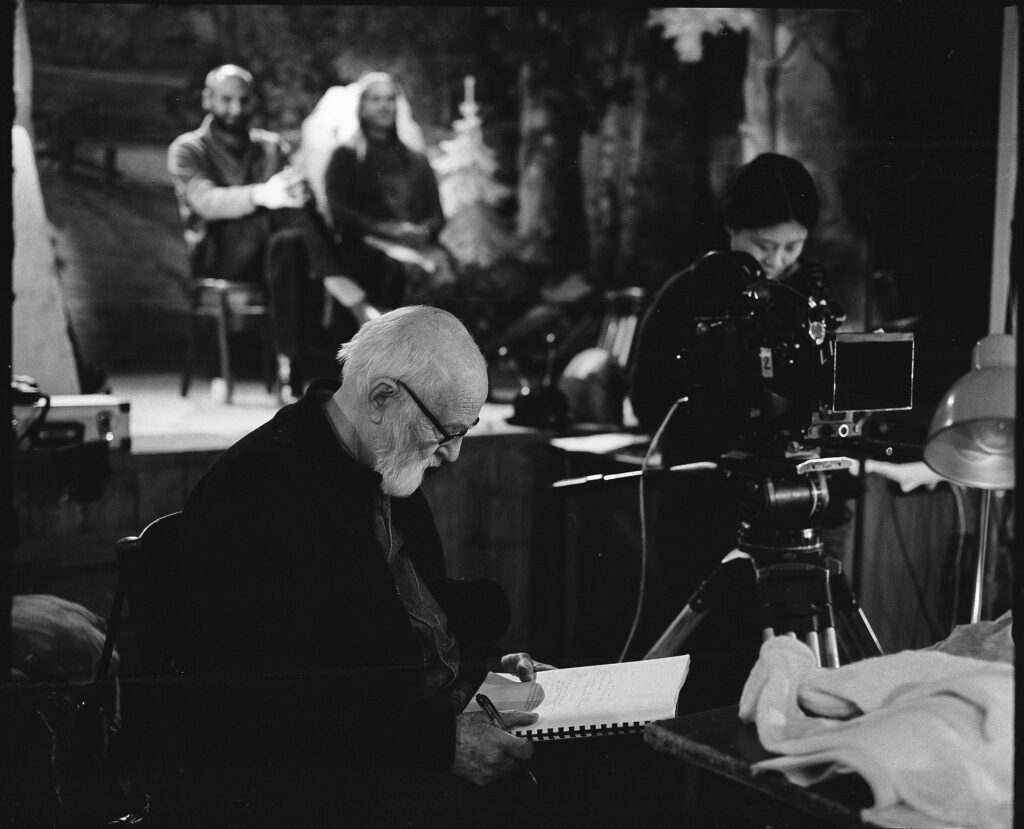
After completing what is likely Švankmajer’s final film, Insects, on which we both collaborated-Adam Ol’ha as the cinematographer of the documentary line and Jan Daňhel as editor-we were approached by film producer Jaromír Kallista and the surrealist Jan Švankmajer to attempt, through film, to preserve the creative processes fermenting within the depths of their film company, Athanor.
Within Athanor-the Alchemical furnace-three principles are in tension. The third is Eva Švankmajerová, who passed away twelve years ago, yet remains all-pervading. Three principles: Mercury, Sulfur, and Salt, the one that holds everything together so it does not explode. A producer and a surrealist-how do they coexist? Are they communicating vessels? Can obsessions, aversions, magical thinking, play, infantilism, imagination, and the unconscious-something so inherently fluid and processual-be sold at all? Can the creative process be priced and monetized? Where does it actually come from-what is its source?
At the same time, we were somewhat apprehensive about Jan Švankmajer’s well-known reserve, as he had previously firmly rejected self-presentation. We were therefore surprised that he allowed us into quite intimate layers and intricate recesses.
Alchemy is not merely about making gold; it is always also about a transformation of the mind. Just as the mixture is purified in the alchemical furnace-athanor-the author–alchemist is transformed as well. Only when the operator is authentically present can this transformation be conveyed to the viewer. We participated in this process with humility and were aware from the very beginning that our film must belong to the realm of “imaginative” cinema.
However, we did not want to imitate Švankmajer’s style in any way. Rather than an aesthetic model, we chose an obsessive mode of filming-an organic, associative, and alchemical approach. We forbade ourselves conceptual deliberations and preplanned ideas. We simply waited, and with this awareness we gladly allowed ourselves to be lured into a magical world-into an adventurous game of making an obsessively “parasitic film.”
Adam Ol’ha, Jan Daňhel